
Auto-Enrolment for Free School Meals: The “Missing Claim” That Creates Hunger
// NO DESCRIPTION DATA
Hunger
Parents don’t “choose hunger.” A lot of the time, hunger shows up because the system makes support hard to claim, easy to miss, and embarrassing to ask for.
One of the cleanest examples is Free School Meals. The money exists. The entitlement exists. But a chunk of eligible families never get it, because the claim process relies on forms, awareness, time, and confidence.
The real problem is the claim, not the need
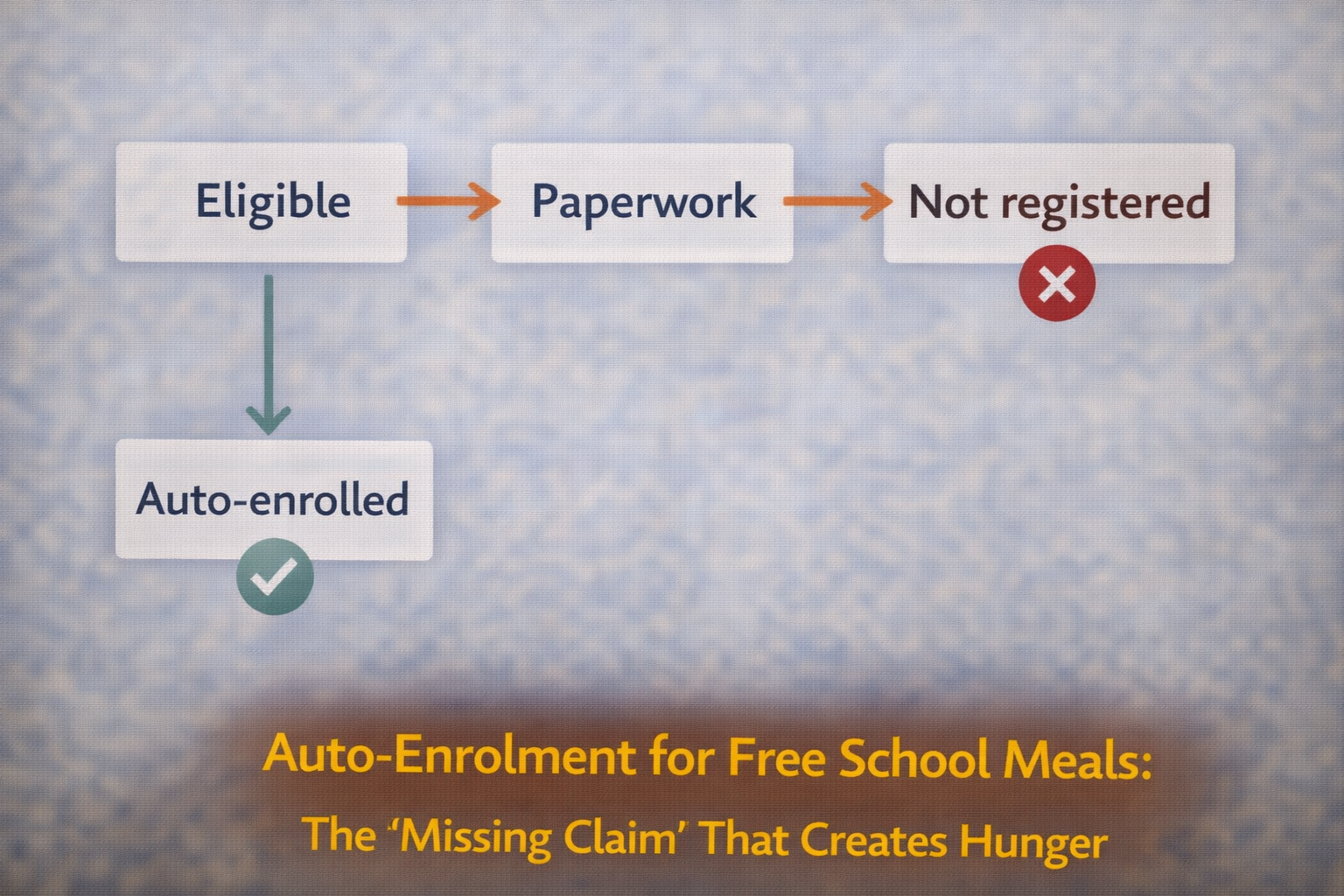
Even when families qualify, registration can be missed during job changes, moves, language barriers, chaotic living situations, or because parents assume schools will “sort it automatically.” They won’t. The result is children missing meals and schools missing linked funding.
A policy fix already on the table is auto-enrolment (sometimes framed as “auto-registration”), where eligibility is matched centrally and families are enrolled without needing to apply, with an opt-out if needed. This has been discussed in Parliament and covered by official briefings.
Auto-enrolment also protects school funding
This is the part most people miss: FSM registration isn’t just lunch. It can trigger additional support funding to schools (often through linked mechanisms like pupil premium). So under-claiming doesn’t just harm the child today. It reduces the school’s ability to provide support tomorrow.
Pilot work and advocacy groups have pointed to auto-enrolment as a practical way to reduce under-registration and protect both children and school budgets.
Why stigma and admin friction are “hidden hunger” multipliers
If a parent has to declare hardship repeatedly, prove it, re-prove it, or navigate confusing portals, you get predictable outcomes: fewer claims, more shame, and more kids falling through gaps.
Auto-enrolment flips the burden. It turns “prove you’re struggling” into “if you qualify, you get it.”
What this means for Feed & Flow
Feed & Flow can talk about hunger without doing the tired “food parcels fix everything” routine, by pushing a smarter message: reduce friction, increase take-up, protect dignity. That aligns with a model of funding and supporting local food projects while staying transparent about what’s being done and why.