
Food That Feels Like Home: Why Culturally Appropriate Support Matters To Feed & Flow
// NO DESCRIPTION DATA
Food is never just fuel.
It carries memory, identity and culture.
For people from minority ethnic communities, migrants, refugees and people of different faiths, “any food is better than none” is not always true. If support ignores culture and dietary needs, it can leave people hungry despite full parcels.
Feed & Flow Foundation takes culturally appropriate food seriously when it considers which projects to fund.
When standard parcels do not fit
Many traditional food parcels are based on a narrow view of what a “typical” household eats. That often means:
- Tinned meat products that are not halal or acceptable for certain faiths
- Items that do not match cultural cooking habits
- Lack of staples like specific grains, flours, spices or vegetables
- A focus on oven cooking in homes that mainly use hobs or different equipment
People describe accepting parcels to avoid embarrassment, then needing to give parts away, swap them or go without.
That is not dignity. It is waste.
Culturally appropriate food as basic respect
Feed & Flow looks for projects that:
- Ask communities what they actually want and need
- Stock halal, kosher, vegetarian or other options where relevant
- Offer familiar ingredients alongside new ones
- Recognise different cooking styles and storage needs
This is not about creating dozens of separate systems. It is about building flexibility and listening into one shared one.
The link between migration, asylum and food insecurity
People seeking asylum, those with no recourse to public funds and new arrivals often face:
- Very limited income or allowances
- No right to work
- Language barriers when navigating local systems
- Isolation from family support networks
Access to food that feels familiar can be one of the few sources of comfort and stability.
Feed & Flow is keen to support projects that:
- Work directly with refugee and migrant organisations
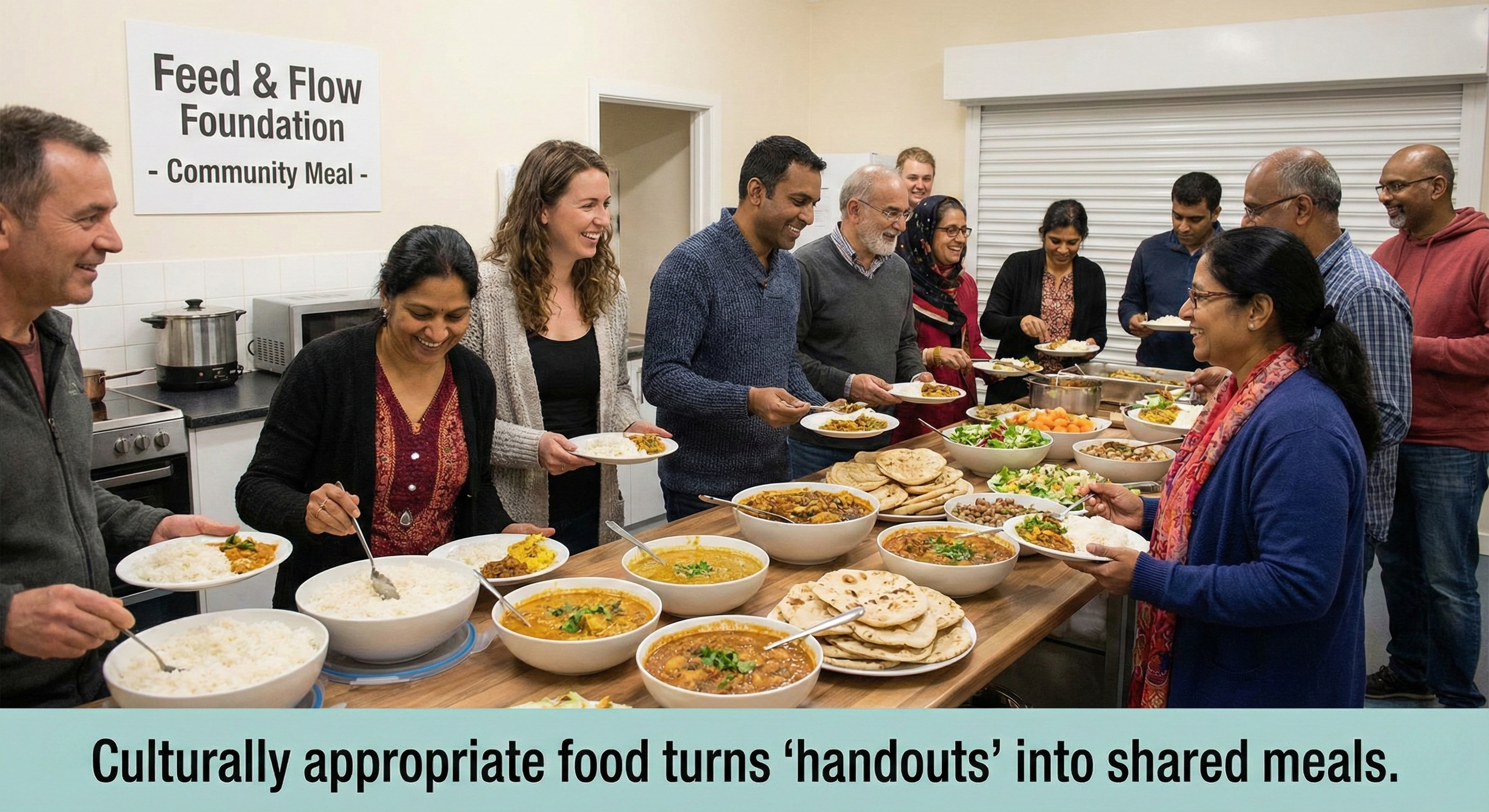
- Run community meals where cultures meet on equal terms
- Provide information in multiple languages where possible
Food support should not ask people to leave their culture at the door.
Shared tables, shared decisions
Some of the most powerful projects combine culturally appropriate food with shared decision-making.
That might look like:
- Community kitchens where participants help plan menus
- Co-ops or pantries where people choose their own items within a points system
- Volunteer teams drawn from the same communities being supported
When people can see themselves in the food, the space and the team, support feels less like charity and more like community.
Feed & Flow sees this as a sign of strong, respectful design.
Balancing cost with inclusion
Providing a wider range of food can be more complex and, sometimes, more expensive. Projects have to balance:
- Limited storage
- Shorter shelf lives
- Specialist sourcing
Feed & Flow’s funding can help:
- Cover additional costs of culturally important staples
- Support partnerships with specialist suppliers and local shops
- Back projects that share learning on what works
In return, the foundation expects projects to keep listening and adjusting – not to tick a box once and move on.
Food support that ignores culture risks entrenching inequality.
Food support that respects culture can become a bridge between communities instead.