
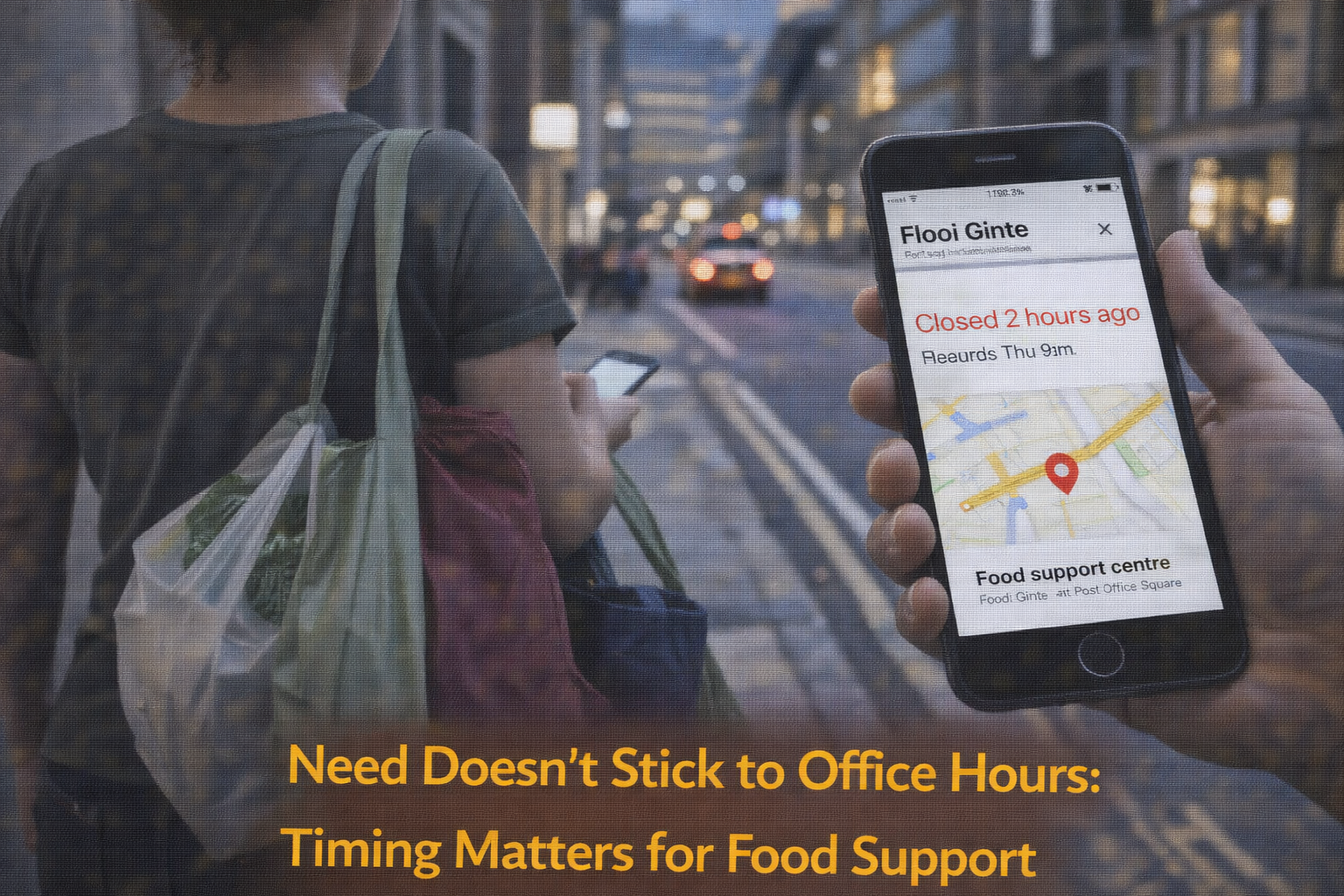
Hunger Does Not Happen 10 to 2: Why Food Support Opening Hours Miss Working Households
// NO DESCRIPTION DATA
Food Support
A lot of food support is built around the timetable of organisations, not the timetable of people in crisis.
That sounds small. It is not.
If support is only open during limited weekday hours, many working households face a brutal choice. Miss work and lose money, or keep working and miss the support. For people already stretched thin, neither option is good.
Need Does Not Arrive at Convenient Times
Food insecurity does not stick to office hours.
It hits after rent day, after a late shift, after school pick-up, after an unexpected bill, after a weekend when the cupboards ran down faster than expected. Yet many support systems still assume people can show up in the middle of the day, stand in line, and build their week around access.
That assumption breaks down fast for people in low-paid work, zero-hours jobs, shift roles, or unstable schedules. The people trying hardest to keep going can be the ones least able to reach help when it is technically available.
“Available” on Paper Can Still Mean Out of Reach
This is one of the most common failures in support design.
A service can exist, be well-run, and still miss the households who need it if the timing does not match real life. A parent finishing work at 5pm does not care that help was available at 11am. A carer managing appointments cannot always drop everything to get to a collection point before lunch. Someone on public transport may not be able to make the trip within a narrow window at all.
The result is predictable. People delay asking for help, stretch meals further, skip food themselves, or rely on more expensive convenience options because the structured support was never truly reachable.
Feed & Flow Should Keep Time in the Design
This matters for any charity serious about reducing food insecurity.
Good support is not only about what is offered. It is also about when and how people can realistically access it. Evening access, weekend availability, local partnerships, flexible distribution, and better coordination all matter if the goal is to meet people where their lives actually are.
Feed & Flow should keep pushing beyond the idea that existence equals accessibility. It does not.
If a family cannot reach help without risking wages, childcare, or transport chaos, the support has a gap built into it from the start.
Because hunger does not politely wait for the next opening slot.