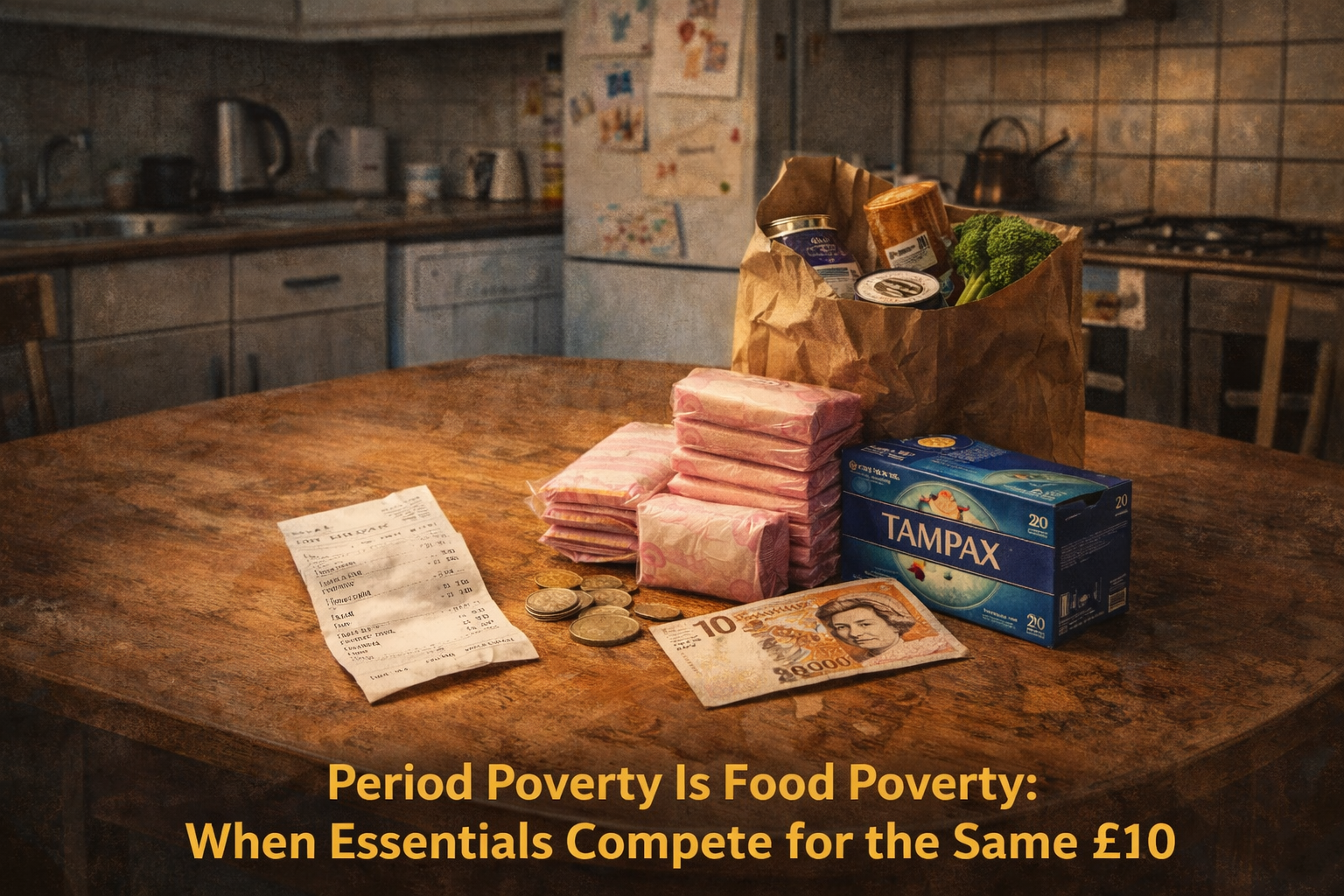
Period Poverty Is Food Poverty: When Essentials Compete for the Same £10
// NO DESCRIPTION DATA
The trade-off people don’t talk about
Period poverty is often framed as a “hygiene issue”.
But in real life, it’s a household budget collision:
when money is tight, period products compete with food, energy, transport, and school costs.
Plan International UK reported that half of girls who struggle to afford period products cut back on food to pay for them.
That’s not a minor inconvenience.
That’s hunger by another name.
Why this pressure got worse during the cost-of-living crisis
The cost-of-living squeeze didn’t create period poverty, but it made it sharper.
The Royal College of Nursing notes period poverty in the UK has been exacerbated by the cost-of-living crisis, as people prioritise basic necessities over period products.
Except period products are also basic necessities.
So households are forced into impossible choices.
“Free period products” exists, but it doesn’t solve the whole problem
England’s period product scheme provides free products to eligible schools and colleges.
That helps. It matters.
But it doesn’t cover:
- people not in education settings
- people who need products outside school hours
- households where the problem is wider than one item
A scheme can reduce pressure, but it doesn’t rebuild stability.
Hunger looks different when it’s hidden behind a hygiene need
When the budget breaks, people improvise:
- skip meals
- reduce portions
- delay grocery shopping
- “make it last” for the kids
And unlike many household bills, this one comes back every month.
That means period-related food pressure is not random.
It’s predictable, recurring, and avoidable.
What good support looks like
Support works best when it reduces the number of “trade-off moments”.
That means linking:
- food support
- practical household essentials
- referral pathways
- cash-first help where appropriate
Because when someone’s choosing between food and period products, the real problem is not the product.
It’s the gap.
What Feed & Flow can do here
Feed & Flow’s role isn’t “period product delivery” alone.
It’s building stability routes, so families are not forced into monthly survival maths:
- connect people to local support quickly
- reduce crisis dependence
- protect dignity and choice
- recognise women and girls as part of household hunger reality
If someone is skipping food to afford basics, that’s food insecurity.
Even if it doesn’t look like it on paper.