
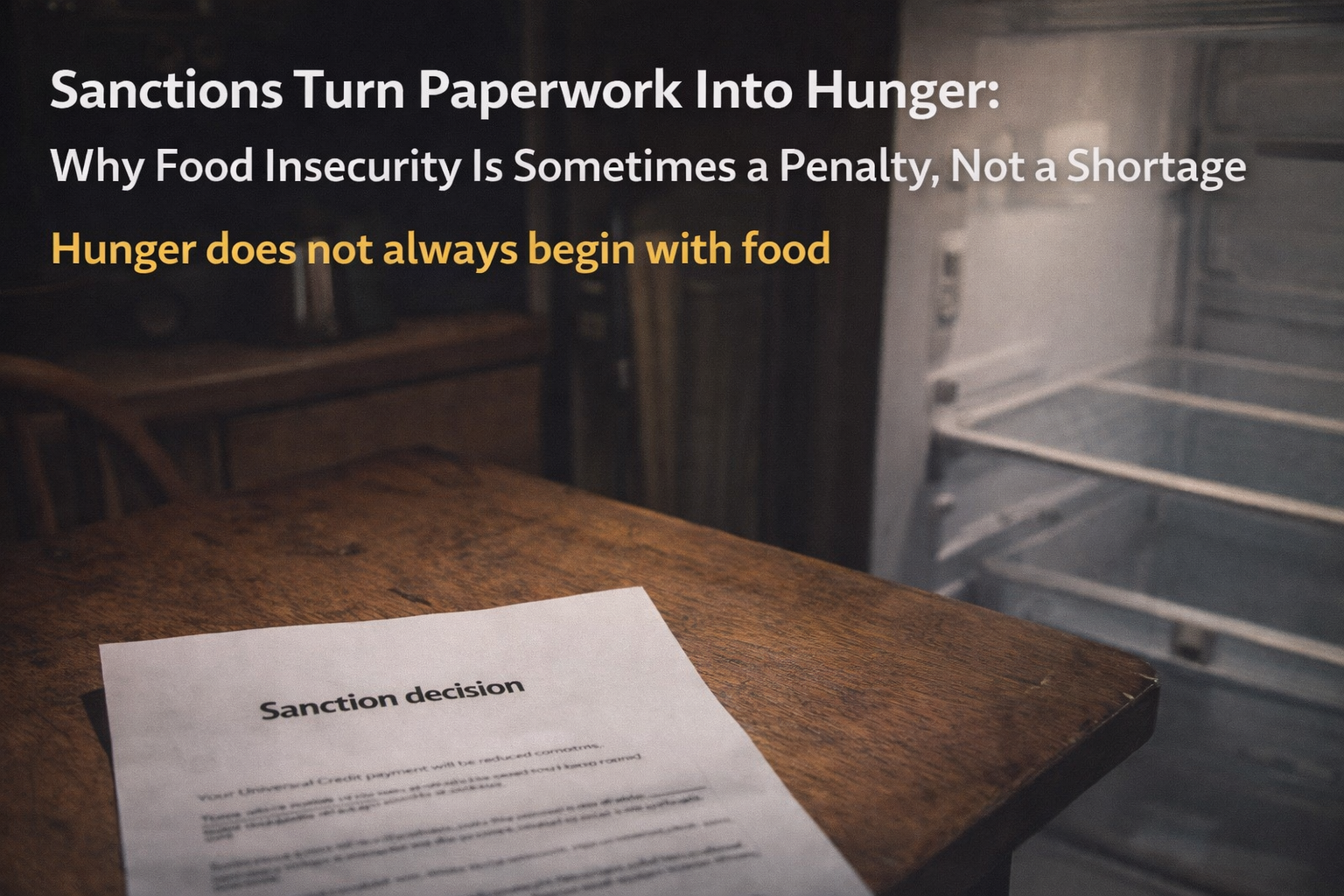
Sanctions Turn Paperwork Into Hunger: Why Food Insecurity Is Sometimes a Penalty, Not a Shortage
// NO DESCRIPTION DATA
Hunger does not always begin with food
A lot of food insecurity begins with cash flow, and sometimes cash flow is removed deliberately.
Benefit sanctions reduce income for a period because of missed appointments, admin errors, or failures to meet job-search requirements. Even “low-level” sanctions can wipe out the standard allowance, pushing people towards food banks, debt, and crisis borrowing.
The problem is not just the policy, it is the volatility
The most damaging thing for household stability is unpredictable income. When money drops suddenly:
- rent and bills still land
- direct debits still pull
- travel costs still exist
- children still need food
So the household cuts what it can cut fastest: food.
There is also evidence linking sanctions and food bank referral levels.
Why this becomes a repeat-crisis loop
A sanction does not just create hunger for a week. It creates knock-on damage:
- arrears that persist
- debt repayments that reduce future budgets
- stress that affects decision-making
- missed appointments because travel money disappears
This is how a short penalty becomes a long instability.
What Feed & Flow focuses on
Feed & Flow supports work that reduces repeat crises, not just visible hunger.
That means we pay attention to:
- whether local support can intervene fast
- whether people can access help without complex barriers
- whether advice and advocacy are part of the model
Practical support that actually prevents hunger
In sanction-driven hardship, the most effective help is often:
- cash-first emergency support (so households can plug the biggest hole fast)
- travel and access support (so people can attend appointments and avoid repeat sanctions)
- advice partnerships with organisations that can challenge incorrect decisions or help people navigate requirements
Food parcels can keep someone alive. But if the person is sanctioned again next month, the hunger returns. The system needs stabilisers.
Why this is a dignity issue
When hunger is produced by administrative penalties, people are forced to “prove” hardship while already in crisis.
Feed & Flow’s approach is to fund models that treat people like humans in a hard system, not suspects in a moral test.