
Split Homes, Split Budgets, Split Fridges: The Hidden Food Strain in Shared Parenting
// NO DESCRIPTION DATA
Food Insecurity
Food insecurity policy often imagines one household, one kitchen, one shopping pattern.
A lot of families do not live like that.
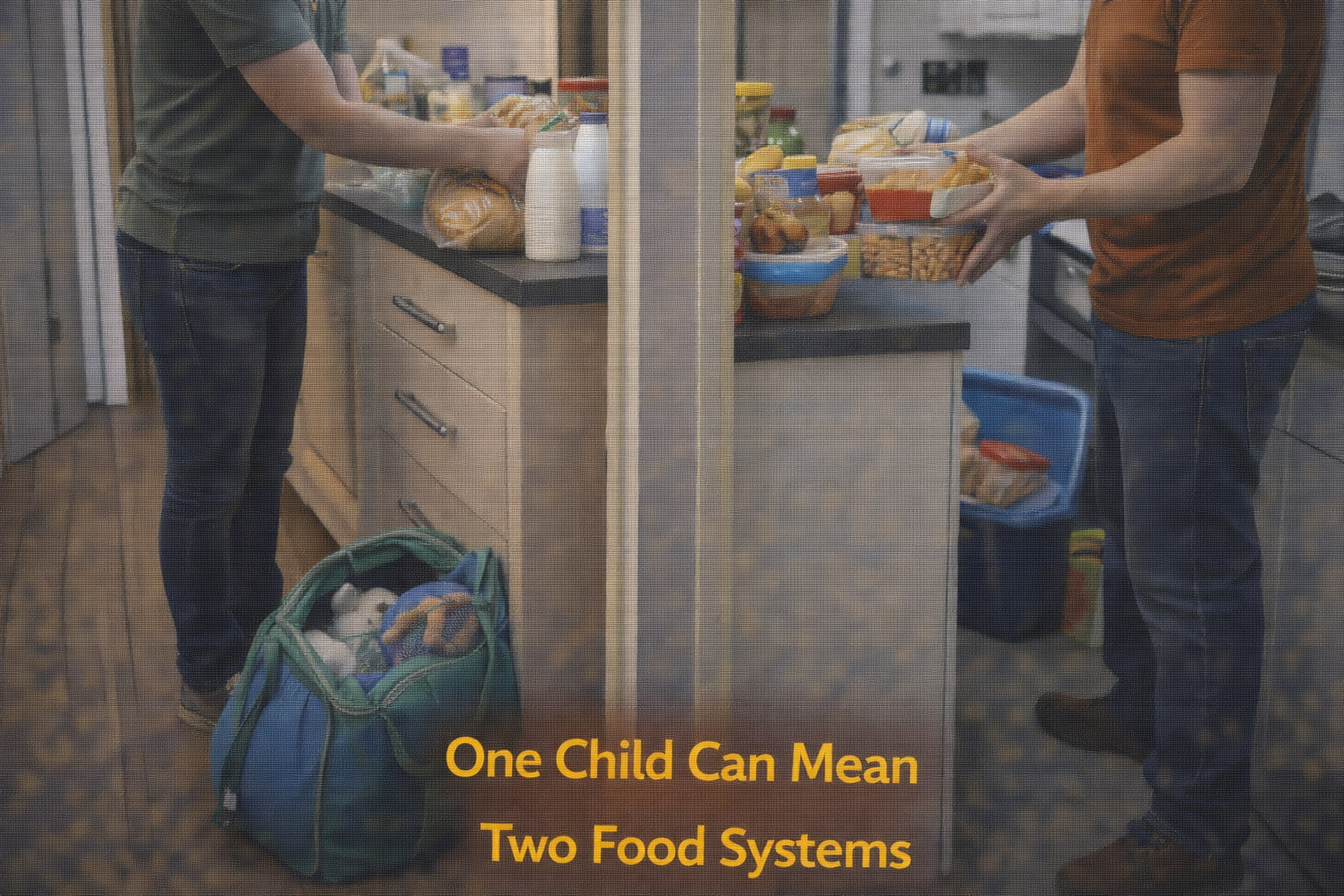
When parents live separately, the cost of keeping children fed and comfortable can rise in ways that ordinary household measures miss. Two fridges, two cupboards, duplicated basics, last-minute handovers, travel between homes, and different income levels all create friction. The result is not always dramatic crisis. Sometimes it is a constant low-grade squeeze.
One Child Can Mean Two Food Systems
Shared parenting can be loving, committed, and still financially hard.
A parent may need to keep food ready for a child who is only there part of the week. That means buying staples that may not get used efficiently, topping up snacks, keeping breakfasts and packed-lunch basics available, and absorbing sudden changes to plans. If money is already tight, duplication becomes expensive fast.
This is especially difficult when one home is much better resourced than the other. Children move between different standards of ease, access, and food routine. The parent with less money may feel pressure to hide that gap while still trying to provide normality.
Hunger Can Sit Inside Family Complexity
This is not always picked up by mainstream support models.
A family can look “fine” on paper while one parent quietly struggles to cover food every time the schedule changes. Informal arrangements, variable contact, transport costs, and uneven financial support can all chip away at food security. The strain may be episodic rather than constant, but it is real.
Children also feel these differences quickly. Not only in portion size or quality, but in stability, routine, and the sense of whether food is relaxed or tense.
Feed & Flow Should Notice the Family Shapes Systems Ignore
Food insecurity is not always about a single fixed household under one roof. Modern family life is more complicated than that, and support needs to reflect it.
Feed & Flow should keep an eye on the households that fall between categories: not obviously in crisis, not cleanly measured, but repeatedly under strain because family life requires food to stretch across more than one home.
Because when budgets, routines, and kitchens are split, the pressure does not disappear.
It just gets spread thin.